It occurred to me that one of the key factors that separates what is art from what is not, is the power of suggestion. Looking around you, you can see all sorts of everyday objects, mostly mundane, that don't seem to have anything special about them.
But take, for example, that urinal mentioned a few posts back- Duchamp's "Fountain". It is presented as art, and therefore people begin to see it as such. While there is much controversy over the topic, the idea is still there in the minds of the people who have seen it.
Friday, February 26, 2010

Wednesday, February 24, 2010
Perspective
It bring cloud-gazing to mind; maybe a skeptic would say "It's just a cloud," or perhaps find the only meaning in it to be part of the water cycle, essential to the weather, but nothing more. But then, those more open-minded folk would look up and say that it's a dog, a dragon, a teacup- or if you look at it just so, you can find wisps of nostalgia among the clouds.

Is everything of artistic value?
I can understand that such an idea would make someone skeptical; believe me, I was too, at first. But bear with me a moment as I lead you through my thought process.
My composition teacher read my previous post, and suggested that I look into Duchamp's "Fountain". I did, and found it was rather in keeping with the subject of just what makes something art.
 Skeptics may look at this and say, "It's a urinal. How could this possibly be art?" But then, isn't it often said that beauty is in the eye of the beholder? It's all in the perspective. I personally love the idea that something ordinary can mean something entirely different if you just look at it from a different view.
It's common in photography, to simply take a picture of something at an interesting angle- and that's what art often is. Here's a different way of looking at it, isn't that cool? Much art is called so because it pleases the eye, or is interesting simply because it does not. Then there's the art which makes a satire of some sort, or presents an idea through symbolism. People can find meaning in anything if they try hard enough. Just about anything can appeal to someone somehow, whether to their eye or mind. It's all in your perspective. If you think about it that way and are inclined to appreciate the little things, then maybe anything can be art- and that would make life a lot more interesting, now wouldn't it?
My composition teacher read my previous post, and suggested that I look into Duchamp's "Fountain". I did, and found it was rather in keeping with the subject of just what makes something art.
 Skeptics may look at this and say, "It's a urinal. How could this possibly be art?" But then, isn't it often said that beauty is in the eye of the beholder? It's all in the perspective. I personally love the idea that something ordinary can mean something entirely different if you just look at it from a different view.
It's common in photography, to simply take a picture of something at an interesting angle- and that's what art often is. Here's a different way of looking at it, isn't that cool? Much art is called so because it pleases the eye, or is interesting simply because it does not. Then there's the art which makes a satire of some sort, or presents an idea through symbolism. People can find meaning in anything if they try hard enough. Just about anything can appeal to someone somehow, whether to their eye or mind. It's all in your perspective. If you think about it that way and are inclined to appreciate the little things, then maybe anything can be art- and that would make life a lot more interesting, now wouldn't it?
Thursday, February 11, 2010
What constitutes poetry?
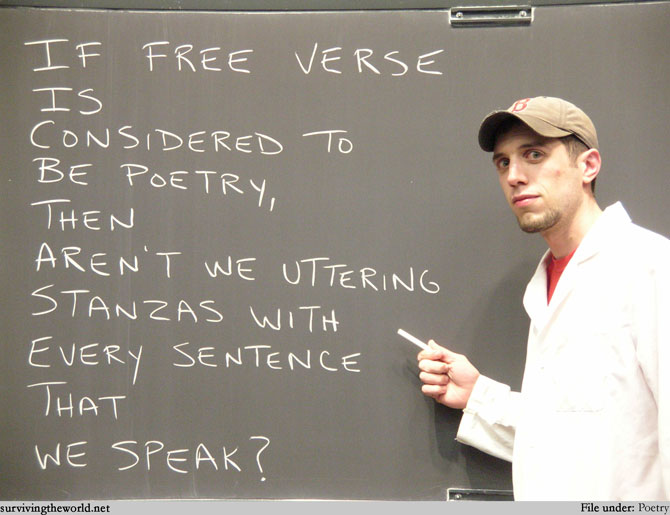
I've wondered about this before, actually. It's true that rhyming doesn't constitute poetry, nor does all poetry rhyme. Some poems make use of a particular rhyme and meter, while some appear to make use of neither. Is there a way to really define poetry as opposed to prose? Indeed, much of it seems to be just interesting or cryptic ideas typed in an uneven manner or with irregular punctuation.
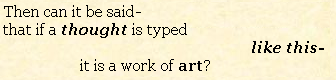
Admittedly, I'm not entirely sure.
Monday, February 8, 2010
Essays and contemporary works
My Composition teacher was telling us in class today how most good writing didn't have what is normally expected to be put in an essay- the thesis in a particular spot, and so forth; 'good writing' doesn't require a format so much, my Comp teacher said, as long as it was interesting. He told us how students are trained with the format as they learn how to write. Otherwise, our essays would be unorganized and sloppy.
While he was discussing this, I began to realize that students are trained much the same way with poetry. In English class, when it comes time for the poetry unit, we're given specifically structured poems- limericks and haiku and the like- to write. We're trained, when writing, to use rhyme and meter a certain way. While this is true for some stereotypical good writers- Emily Dickinson, for example, among other poets we frequently hear about in English class. Let's not forget, though, that there is a more contemporary style found just as often. By reading the works of e.e. cummings, as well as more modern poets, it's plain to see that they lack what we've learned to expect from poetry, yet they certainly do not fail to be interesting.
While he was discussing this, I began to realize that students are trained much the same way with poetry. In English class, when it comes time for the poetry unit, we're given specifically structured poems- limericks and haiku and the like- to write. We're trained, when writing, to use rhyme and meter a certain way. While this is true for some stereotypical good writers- Emily Dickinson, for example, among other poets we frequently hear about in English class. Let's not forget, though, that there is a more contemporary style found just as often. By reading the works of e.e. cummings, as well as more modern poets, it's plain to see that they lack what we've learned to expect from poetry, yet they certainly do not fail to be interesting.
Wednesday, February 3, 2010
Dead Poets Society
I've seen this movie three or four times, and I love it. It's an old movie, but it's still among my favorites. I would give you a plot description, but I never can manage those without rambling too much about every little detail, so I hope the trailer will suffice.
I'm posting this not only because I enjoyed the movie, but also because it demonstrates that poetry isn't always boring- or rather, that it shouldn't be at all; it isn't something to be read dryly and analyzed with detachment, or discussed with monotone voices, as many students tend to imagine it. Nor is it always disgustingly sappy (though it is true that some poems are). When a poet writes, it's not just ink they're putting on the paper- it's ideas, emotions, and often, a piece of themselves. There is life in those words, and should be read as such.
Subscribe to:
Comments (Atom)